

Property Division in Divorce : Going through a divorce is emotionally exhausting — and when assets like your family home, a jointly purchased flat, ancestral gold, or years of hard-earned savings are on the line, the stress can become overwhelming. Property division in divorce in India is one of the most complex, contested, and emotionally charged areas of family law. Whether you are a working professional in Jaipur, a homemaker in Rajasthan, or a couple in any city across India, understanding your legal rights is absolutely critical before you take any action.
In India, the rules governing property division differ based on religion, the type of marriage, and the nature of the asset. Unlike many Western countries, India does not follow a straightforward 50-50 split rule. Instead, courts consider a range of factors — financial contributions, marriage duration, custody of children, and individual need — before arriving at a decision.
If you are searching for the best divorce lawyer in Jaipur to guide you through property disputes with clarity and confidence, you are in the right place. The team at Best Divorce Lawyer in Jaipur — located at 47D SMS Colony, Shipra Path, Mansarovar, Jaipur 302020 — has helped hundreds of Indian families resolve property matters with speed, fairness, and legal precision. You may also refer to the eCourts India portal for official court case tracking and legal procedures.
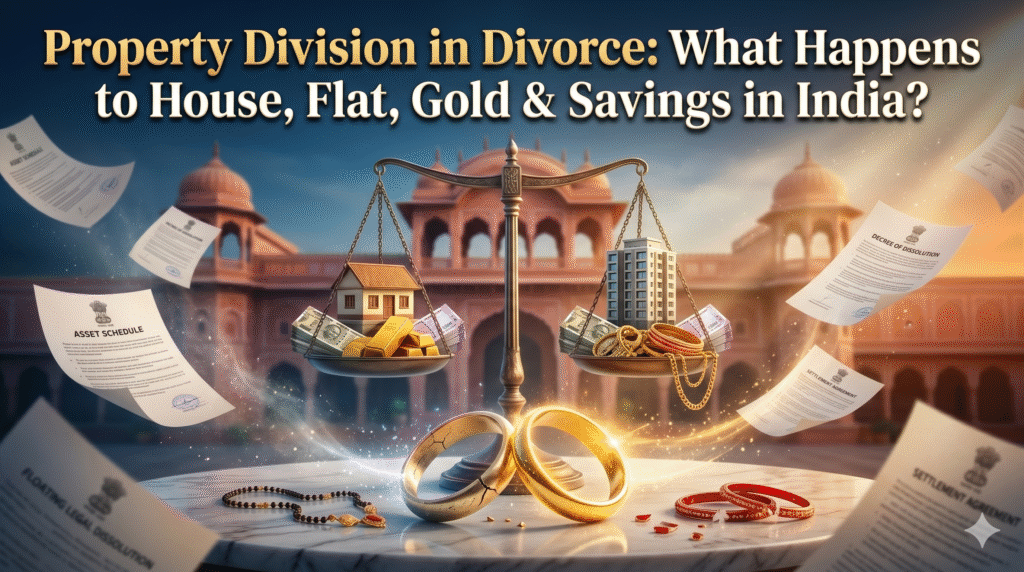
What is Property Division in Divorce? – Complete Definition & Overview
Property division in divorce in India refers to the legal process of identifying, valuing, and distributing marital assets and liabilities between spouses when a marriage legally ends. Unlike criminal law, property division in Indian family courts is not governed by a single unified code. It varies significantly depending on the personal law applicable to the couple.
Under the Hindu Marriage Act, 1955, the Special Marriage Act, 1954, the Muslim Personal Law (Shariat) Application Act, 1937, and the Indian Divorce Act, 1869 (for Christians), courts assess different categories of property — self-acquired, jointly acquired, ancestral, and stridhan (a woman’s exclusive property) — and determine their rightful ownership.
Key categories of property typically considered in Indian divorce cases include:
- Immovable property: Flat, house, plot, agricultural land
- Movable property: Gold jewellery, silver, vehicles, furniture
- Financial assets: Bank accounts, fixed deposits, mutual funds, stocks, PF/EPF, NPS
- Business interests: Partnership shares, private company equity
- Liabilities: Home loans, personal loans, credit card debts
For a deeper understanding of Indian family law and legal aid resources, visit the official India.gov.in legal services page. For personalised legal advice specific to your situation in Rajasthan, contact the top divorce lawyer in Rajasthan at Best Divorce Lawyer in Jaipur — call +91-94-6162-0006 today.
Why Indian Clients Prefer Best Divorce Lawyer in Jaipur for Property Division Cases
When it comes to protecting what matters most — your home, your savings, your future — choosing the right legal team is not optional. It is essential. Best Divorce Lawyer in Jaipur has emerged as the most trusted name in divorce and family law across Rajasthan and pan-India consultations.
Here is why thousands of Indian clients — families, couples, NRIs, and working professionals — choose us:
✅ 15+ Years of Proven Expertise Our senior advocates have handled over 2,000 property division cases across Rajasthan and other Indian states, including complex cases involving multi-city assets, inherited gold, and jointly owned flats.
✅ Deep Knowledge of Indian Family Law Our lawyers are specialists in the Hindu Marriage Act, Special Marriage Act, Protection of Women from Domestic Violence Act, and Maintenance and Welfare of Parents and Senior Citizens Act, among others.
✅ Transparent, Client-First Approach We believe in absolute transparency. Before filing any petition, our team walks you through every possible outcome, timeline, and cost — so you make informed decisions.
✅ Fast-Track Resolution Strategy We prioritise mediation and negotiated settlements wherever possible, saving our clients months of courtroom battles and significant legal fees.
✅ Confidential & Compassionate Every consultation at our office in Mansarovar, Jaipur, is handled with complete confidentiality. Our clients’ dignity and privacy are non-negotiable.
The leading family lawyer in Mansarovar Jaipur team at Best Divorce Lawyer in Jaipur is your strongest legal ally in any property division dispute. We serve clients in Jaipur, across Rajasthan, and across India through virtual consultations. Email us at info@bestdivorcelawyer.in or call +91-94-6162-0006.
Step-by-Step Guide: How Property Division Works in Indian Divorce Cases
Understanding the process empowers you. Here is how property division in divorce in India typically unfolds, step by step:
Step 1 — Identify All Marital Assets Both parties must declare all assets — movable and immovable — owned individually or jointly. Non-disclosure is a legal offence in Indian courts.
Step 2 — Classify the Property Your lawyer will classify each asset as:
- Self-acquired (owned before marriage or gifted exclusively)
- Jointly acquired (purchased during marriage with shared funds)
- Ancestral/inherited (received through family lineage)
- Stridhan (jewellery and gifts exclusively belonging to the wife)
Step 3 — Determine Ownership and Contribution Courts assess who paid for the property, whose name is on the title deed, and what financial or non-financial contribution each spouse made.
Step 4 — File the Appropriate Petition Depending on the type of divorce — mutual consent or contested — your advocate files the relevant petition under the applicable personal law in the Family Court.
Step 5 — Attempt Mediation or Negotiated Settlement Indian courts strongly encourage mediation before contested trials. A fair settlement here saves time, money, and emotional stress for both parties and their children.
Step 6 — Court Hearing and Evidence Submission If mediation fails, both sides present documentary evidence — property papers, bank statements, income tax returns, gold receipts, and home loan documents.
Step 7 — Court Order on Property Division The Family Court issues a final decree specifying who gets what — including interim maintenance, permanent alimony, and division of specific assets.
Step 8 — Transfer of Title and Compliance Post-decree, property titles are legally transferred. Failure to comply with court orders can lead to contempt of court proceedings.
Work with the best law firm in Jaipur for divorce — Best Divorce Lawyer in Jaipur — to navigate each of these steps without errors or delays.
Key Legal Insights, Compliance Rules & Benefits
Property division in divorce in India is governed by multiple laws. Here are the most critical legal insights every Indian client must know in 2026:
1. Hindu Marriage Act, 1955 — Section 27 Courts may settle ownership of any property jointly held by husband and wife during divorce proceedings. This includes gold jewellery, flats bought jointly, and savings accounts held in both names.
2. Stridhan Is Always the Wife’s Stridhan — gifts received at marriage, jewellery from parents and in-laws, and personal gifts — legally belongs exclusively to the wife and cannot be claimed by the husband or his family, per landmark Supreme Court judgements.
3. Matrimonial Home Rights Even if a flat or house is registered only in the husband’s name, the wife has a legal right to reside there under the Protection of Women from Domestic Violence Act, 2005 until an alternate arrangement is made.
4. Maintenance and Alimony Affects Property Settlements Under Section 25 of the Hindu Marriage Act, courts can award permanent alimony in lieu of property rights — or in addition to them — based on income, assets, and lifestyle.
5. EPF, PPF & NPS Are Divisible Indian courts have increasingly recognised that provident fund balances, PPF accounts, and NPS corpus accumulated during the marriage can be subject to equitable division.
Real Case Scenario: In a 2023 Jaipur Family Court case handled by Best Divorce Lawyer in Jaipur, a wife successfully claimed 40% of a jointly purchased flat — despite her name not appearing on the title deed — by proving her financial contribution through bank transfer records.
Common Mistakes & Legal Challenges for Indian Clients
Many Indian clients unknowingly jeopardise their property rights due to lack of legal guidance. Here are the most common mistakes — and how Best Divorce Lawyer in Jaipur helps you avoid them:
❌ Mistake 1 — Assuming the Title Holder Always Wins Many clients believe that whoever’s name is on the property deed automatically wins. This is incorrect. Indian courts look at actual financial contribution, not just registration.
❌ Mistake 2 — Not Documenting Gold and Jewellery Without receipts, photographs, or sworn affidavits, proving ownership of gold and jewellery becomes legally difficult. Document everything now.
❌ Mistake 3 — Signing Documents Without Legal Review Many clients, under emotional pressure, sign settlement agreements without legal review — waiving rights they did not even know they had.
❌ Mistake 4 — Delaying the Filing Process Delay weakens your legal position. Asset transfers, property sales, and account closures can occur while you wait. Act quickly.
❌ Mistake 5 — Ignoring NRI Property Rights Indians living abroad often fail to account for property owned in India. Indian courts retain jurisdiction over Indian property regardless of where the spouses reside.
Best Divorce Lawyer in Jaipur offers an immediate consultation to assess your specific situation and prevent costly mistakes. Call +91-94-6162-0006 or email info@bestdivorcelawyer.in.
Expert Tips from Leading Legal Advisors at Best Divorce Lawyer in Jaipur
Our senior advocates — specialists in property division in divorce in India — share these critical insights:
💡 Tip 1: “Always maintain a personal inventory of all assets — with purchase receipts, valuation certificates, and photographs — before any divorce proceedings begin. Evidence gathered early is your strongest legal weapon.”
💡 Tip 2: “Do not move out of the matrimonial home without legal advice. Vacating the property prematurely can be legally interpreted as voluntary relinquishment of residential rights.”
💡 Tip 3: “Gold given by your parents at the time of marriage is your stridhan — fully protected under Indian law. Never let anyone convince you otherwise.”
💡 Tip 4: “Joint home loans make property division more complex — both parties remain liable until the loan is settled or refinanced. Address this in your settlement agreement explicitly.”
💡 Tip 5: “Mutual consent divorce with a clear property settlement deed is always faster, cheaper, and emotionally less damaging than contested litigation. Explore it with an open mind.”
💡 Tip 6: “In Rajasthan, Family Courts have seen increasing awareness about women’s property rights. Engage the best divorce lawyer in India 2026 to leverage the latest judicial trends in your favour.”
Conclusion + Strong Call to Action
Property division in divorce in India is not just a legal formality — it is a battle for your financial future, your home, and your security. Whether you are concerned about a jointly bought flat in Jaipur, ancestral gold, a shared bank account, or years of EPF savings, you have legal rights — and those rights must be protected by an expert.
The key takeaways from this guide:
- Property division in India is not automatic or equal — it requires legal strategy.
- Stridhan is always the wife’s property and fully protected by law.
- Both self-acquired and jointly acquired assets are considered in divorce.
- Quick action, complete documentation, and expert legal representation are essential.
- Mediation is faster, cheaper, and often better for all parties involved.
Best Divorce Lawyer in Jaipur is ready to fight for your rights — with experience, empathy, and an unmatched track record across Rajasthan and India.
📍 Visit Us: 47D SMS Colony, Shipra Path, Mansarovar, Jaipur 302020 📧 Email: info@bestdivorcelawyer.in 📞 Call Now: +91-94-6162-0006
👉 Book Your Confidential Consultation Today — because your rights cannot wait.
❓ Frequently Asked Questions (FAQ)
Q1. How is property divided in divorce in India — does each spouse get 50%? No, India does not follow a mandatory 50-50 property split in divorce. Courts assess contribution, ownership proof, financial need, and applicable personal law before deciding the division. The best divorce lawyer in Jaipur can evaluate your specific entitlement and build a strong legal strategy.
Q2. Can a wife claim the matrimonial home even if it is in the husband’s name? Yes. Under the Protection of Women from Domestic Violence Act, 2005, a wife has the right to reside in the matrimonial home regardless of ownership. For contested cases, the top divorce lawyer in Rajasthan at Best Divorce Lawyer in Jaipur can secure residence rights swiftly.
Q3. Is gold jewellery (stridhan) included in property division in divorce in India? No. Stridhan — gold and gifts received at marriage or from parents — is legally the wife’s exclusive property under Indian law and Supreme Court rulings. The best law firm in Jaipur for divorce will ensure your stridhan is fully protected during proceedings.
Q4. Can savings, FDs, and mutual funds be divided in an Indian divorce case? Yes. Financial assets like savings accounts, fixed deposits, PPF, EPF, NPS, and mutual funds accumulated during marriage can be subject to equitable division. Consult the leading family lawyer in Mansarovar Jaipur to understand exactly what you are entitled to claim.
Q5. How long does property division take in Indian divorce cases in 2026? A mutual consent divorce with a property settlement agreement can be resolved in 6–18 months. Contested property division cases may take 2–5 years. The best divorce lawyer in India 2026 at Best Divorce Lawyer in Jaipur actively works to minimise timelines through mediation and aggressive legal strategy.
