

If you and your spouse have mutually agreed to end your marriage, you are already one step ahead of a contested legal battle. But even in a mutual consent divorce, many Indian couples feel anxious walking into a courtroom — not knowing what questions the judge asks in mutual consent divorce proceedings.
This guide is written specifically for families, working professionals, and couples in Jaipur, Rajasthan, and across India who want to understand exactly what happens inside the courtroom — and how to prepare with confidence.
At Best Divorce Lawyer in Jaipur, located at 47D SMS Colony, Shipra Path, Mansarovar, Jaipur 302020, our senior legal team has guided hundreds of couples through smooth, dignified mutual consent divorce proceedings under Indian family law.
Whether you are based in Jaipur, Jodhpur, Delhi, or anywhere across India, understanding the judicial process protects your rights and eliminates costly surprises. You can also explore our detailed [consultation services page] to book a private session with India’s most trusted divorce law firm. For a broader legal framework, visit the official eCourts India portal for case-related government resources.
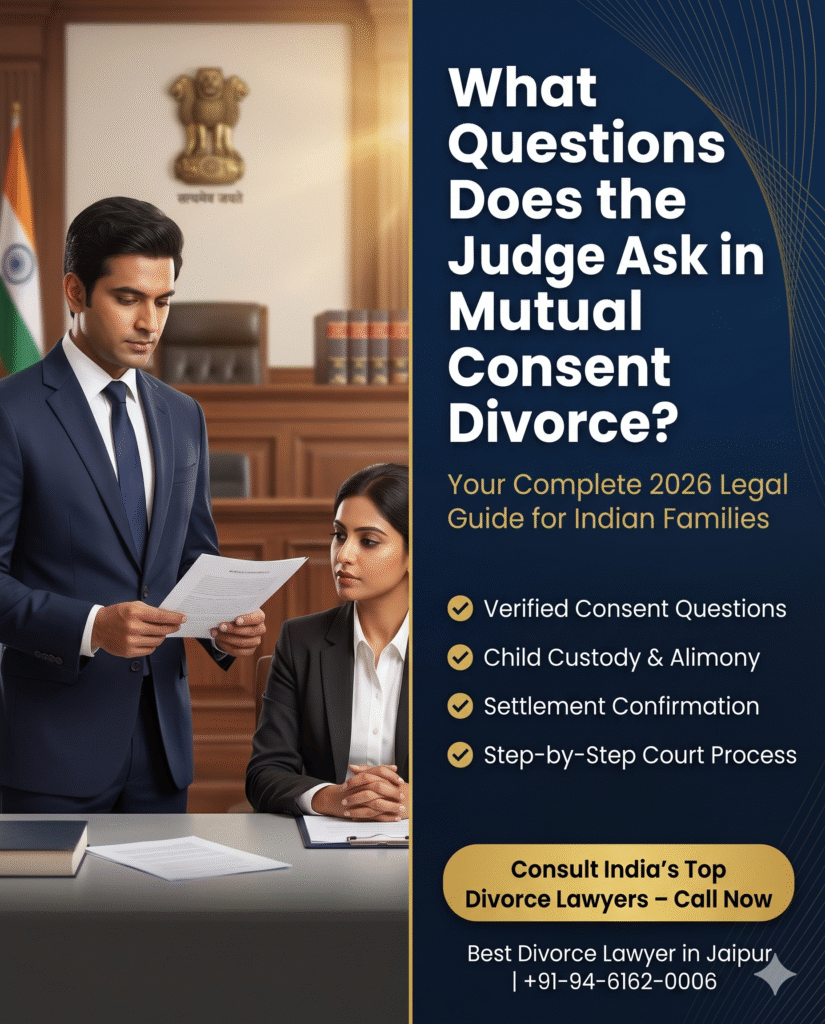
What is Mutual Consent Divorce? – Complete Definition & Overview
Mutual consent divorce — legally termed under Section 13-B of the Hindu Marriage Act, 1955 — is a legal dissolution of marriage where both spouses voluntarily agree to separate without blame, hostility, or dispute.
It is available to Hindu, Buddhist, Sikh, and Jain couples under the Hindu Marriage Act, and to inter-religion couples under Section 28 of the Special Marriage Act, 1954.
For a mutual consent divorce to be valid under Indian law, the following conditions must be met:
- Both spouses must have lived separately for a minimum of one year
- Both must mutually agree that the marriage has irretrievably broken down
- Both must consent to the divorce terms — including alimony, child custody, and property division
The process involves two court motions — a first motion, followed by a mandatory cooling-off period of six months (which courts can waive in genuine cases), and then a second motion where the judge grants the final decree.
Understanding what questions the judge asks in mutual consent divorce during these hearings is essential. You can verify procedural rules directly from india.gov.in’s family law resources or speak directly with Best Divorce Lawyer in Jaipur for personalised legal clarity.
Why Indian Clients Prefer Best Divorce Lawyer in Jaipur for Mutual Consent Divorce
When you search for the best divorce lawyer in Jaipur or the top divorce lawyer in Rajasthan, one name consistently leads the results — Best Divorce Lawyer in Jaipur, Mansarovar.
Here is why thousands of Indian families trust us:
- ✅ 20+ years of combined family law experience across Rajasthan High Court and district courts
- ✅ 500+ successful mutual consent divorce cases handled with discretion and speed
- ✅ Deep expertise in Hindu Marriage Act, Special Marriage Act, Domestic Violence Act, and POCSO compliance
- ✅ Fluent in both Hindi and English — serving pan-India clients remotely
- ✅ Complete document preparation, court filing, and judicial representation under one roof
- ✅ Rated among the best law firms in Jaipur for divorce by verified client reviews
- ✅ Transparent fee structure — no hidden charges, no surprises
Our leading family lawyers in Mansarovar, Jaipur understand that divorce is not just a legal event — it is a deeply emotional transition. We treat every client with the professionalism and human sensitivity they deserve.
📞 Call us now: +91-94-6162-0006 📧 Email: info@bestdivorcelawyer.in
Step-by-Step Guide: What Questions Does the Judge Ask in Mutual Consent Divorce?
Here is exactly what happens during your court appearances — and what the judge will ask:
First Motion Hearing
1. Verification of Identity The judge will ask both parties to confirm their full legal names, addresses, and relationship to each other.
2. Confirmation of Marriage
- “When and where were you married?”
- “Is the marriage certificate authentic and registered?”
3. Confirmation of Separation Period
- “How long have you been living separately?”
- “Can you confirm you have lived apart for at least one year?”
4. Voluntary Consent Verification
- “Are you filing this petition of your own free will?”
- “Has anyone pressured, forced, or coerced you into agreeing to this divorce?”
5. Settlement Agreement Confirmation
- “Have you mutually agreed on alimony/maintenance terms?”
- “Have you resolved child custody and visitation arrangements?”
- “Is the division of property and assets mutually accepted?”
Second Motion Hearing (After Cooling-Off Period)
6. Reconfirmation of Consent
- “Do you still wish to proceed with the divorce?”
- “Has your decision changed since the first motion?”
7. Child Welfare Questions (if applicable)
- “What custody arrangement have you agreed upon?”
- “How will the child’s education, healthcare, and daily needs be managed?”
8. Final Declaration
- “Are both parties satisfied with all terms of the settlement?”
Once both spouses answer affirmatively and the judge is satisfied, the divorce decree is granted.
The best divorce lawyer in India 2026 — our team at Best Divorce Lawyer in Jaipur — prepares every client with mock court preparation, ensuring no anxiety and no errors on the day.
Key Legal Insights, Compliance Rules & Benefits
Understanding the legal framework behind mutual consent divorce helps you navigate the process with clarity.
Applicable Laws:
- Section 13-B – Hindu Marriage Act, 1955
- Section 28 – Special Marriage Act, 1954
- Section 10-A – Divorce Act, 1869 (for Christian couples)
Important Compliance Points:
- The six-month cooling-off period can be waived by the Supreme Court or High Courts if the marriage has irretrievably broken down (SC ruling in Amardeep Singh vs Harveen Kaur, 2017)
- Both parties must be physically present in court (or appear through authorized power of attorney in specific cases)
- A joint divorce petition must be filed with settlement terms clearly documented
- All agreements regarding alimony, stridhan, and property must be in writing before filing
Real Scenario: A working couple in Jaipur — both IT professionals — approached Best Divorce Lawyer in Jaipur after two years of separation. With their child custody and flat ownership already agreed upon informally, our team formalized the agreement legally, prepared a joint petition, and obtained their divorce decree within 45 days of the second motion. No court battles. No delays.
Common Mistakes & Legal Challenges for Indian Clients
Even in mutual consent divorce, errors can delay your case by months. Here are the most common mistakes Indian clients make:
❌ Mistake 1 – Incomplete Documentation Missing marriage certificates, address proofs, or separation evidence causes adjournments.
❌ Mistake 2 – Verbal-Only Agreements Courts require all settlements — alimony, custody, property — in written, legally binding form.
❌ Mistake 3 – Not Meeting the One-Year Separation Requirement Many clients attempt to file before completing the mandatory separation period, resulting in immediate rejection.
❌ Mistake 4 – Appearing Without Legal Counsel Judges may ask precise questions. Clients without a lawyer often misunderstand courtroom protocol, leading to avoidable complications.
❌ Mistake 5 – Withdrawing Consent Before Second Motion If one spouse changes their mind between motions, the case converts to a contested divorce — a far longer and costlier process.
How Best Divorce Lawyer in Jaipur Solves This: Our top divorce lawyers in Rajasthan conduct a thorough pre-filing review, prepare all documentation, brief clients on judicial questions in advance, and ensure zero compliance errors — saving time, money, and emotional energy.
Expert Tips from Leading Legal Advisors at Best Divorce Lawyer in Jaipur
Our senior counsel at Best Divorce Lawyer in Jaipur shares the following professional insights:
Tip 1: “Always finalize alimony, maintenance, and property terms before the first motion. Unclear agreements invite judicial scrutiny and delays.” — Senior Family Law Advocate, Jaipur
Tip 2: “Judges in Rajasthan courts specifically assess voluntariness. Any sign of hesitation or inconsistency in answers can stall proceedings. Practice your responses with your lawyer.” — Lead Counsel, Best Divorce Lawyer in Jaipur
Tip 3: “If children are involved, courts prioritize their welfare above all else. Have a detailed, written parenting plan ready before your first appearance.” — Child Custody Specialist, Mansarovar Jaipur
Tip 4: “The six-month waiver is not automatic. You need strong legal grounds and an experienced advocate to argue it successfully before the court.” — High Court Advocate, Rajasthan
Tip 5: “Clients who approach us three to four months before filing always have the smoothest experience. Early preparation is the single biggest factor in a successful outcome.” — Managing Partner, Best Divorce Lawyer in Jaipur
Tip 6: “Choose the best law firm in Jaipur for divorce based on courtroom track record — not just consultation fees. Experience in Rajasthan family courts is non-negotiable.” — Legal Advisor, Best Divorce Lawyer in Jaipur
Conclusion + Strong Call to Action
Knowing what questions the judge asks in mutual consent divorce is not just useful — it is essential. Walking into court informed, prepared, and legally represented is the difference between a dignified resolution and an unnecessarily prolonged legal ordeal.
Key Takeaways:
- Judges verify identity, consent, separation period, and settlement terms
- Both parties must appear voluntarily and answer clearly
- All financial and custody agreements must be in writing before filing
- Legal representation from the best divorce lawyer in Jaipur dramatically improves outcomes
- Early preparation is the most powerful tool you have
At Best Divorce Lawyer in Jaipur, we are committed to making your transition as smooth, respectful, and legally sound as possible. From first consultation to final decree, our team of the top divorce lawyers in Rajasthan stands with you every step of the way.
📞 Book Your Confidential Legal Consultation Today
Best Divorce Lawyer in Jaipur 📍 47D SMS Colony, Shipra Path, Mansarovar, Jaipur – 302020 📞 +91-94-6162-0006 📧 info@bestdivorcelawyer.in 🌐 Visit our [Contact & Consultation Booking Page] to schedule your appointment today.
Pan-India consultations available online and in-person. Hindi and English legal support provided.
❓ FAQ Section
Q1. What questions does the judge ask in mutual consent divorce during the first motion? During the first motion, the judge asks both spouses to confirm their identities, verify the marriage, confirm they have lived separately for at least one year, and ensure that consent is entirely voluntary. The best divorce lawyer in Jaipur prepares clients thoroughly for every question to ensure a smooth, confident court appearance.
Q2. Can a mutual consent divorce be granted without appearing in court in India? In most cases, physical presence is mandatory. However, in exceptional circumstances, courts may allow appearance through a Power of Attorney. Consult the top law firm in Jaipur — Best Divorce Lawyer in Jaipur — for case-specific advice based on your situation and jurisdiction.
Q3. How long does mutual consent divorce take with the best law firm in Jaipur for divorce? Typically, mutual consent divorce takes six to eight months, including the cooling-off period. With strong legal preparation from Best Divorce Lawyer in Jaipur, the process can be expedited to as little as 30–45 days if the cooling-off waiver is successfully argued before the court.
Q4. What documents are required for mutual consent divorce in Rajasthan? Key documents include the marriage certificate, address proof of both parties, proof of one-year separation, passport-size photographs, and a signed settlement agreement covering alimony, custody, and property. The leading family lawyer in Mansarovar Jaipur at our firm handles complete documentation on your behalf.
Q5. Is mutual consent divorce valid for all religions in India? Yes, mutual consent divorce is available under multiple personal laws — the Hindu Marriage Act (for Hindus, Sikhs, Buddhists, Jains), the Special Marriage Act (for inter-religion couples), and the Divorce Act (for Christians). The best divorce lawyer in India 2026 at Best Divorce Lawyer in Jaipur advises clients across all religions and communities throughout Rajasthan and pan-India
