

Can you file divorce within 1 year of marriage in India? :Marriage is considered sacred in India — but what happens when that sacred bond turns into a source of pain, abuse, or suffering within just a few months? Many Indian couples, especially in Rajasthan and across the country, find themselves trapped in marriages that have broken down almost immediately. A critical question that families, individuals, and working professionals in Jaipur ask is:
The short answer is: generally, no — but with important exceptions.
Under Indian family law, there is a statutory waiting period before filing a divorce petition. However, the law also recognizes that certain circumstances — particularly cruelty, abuse, and other extreme situations — demand urgent legal intervention. For residents of Jaipur, Rajasthan, and across India, understanding these legal exceptions can be life-changing.
At Best Divorce Lawyer Jaipur, we have guided hundreds of clients through exactly this situation with compassion, precision, and powerful legal advocacy. If you are facing a similar crisis, contact our legal team immediately for a confidential consultation. You may also refer to the official eCourts India portal to understand how Indian family courts operate.
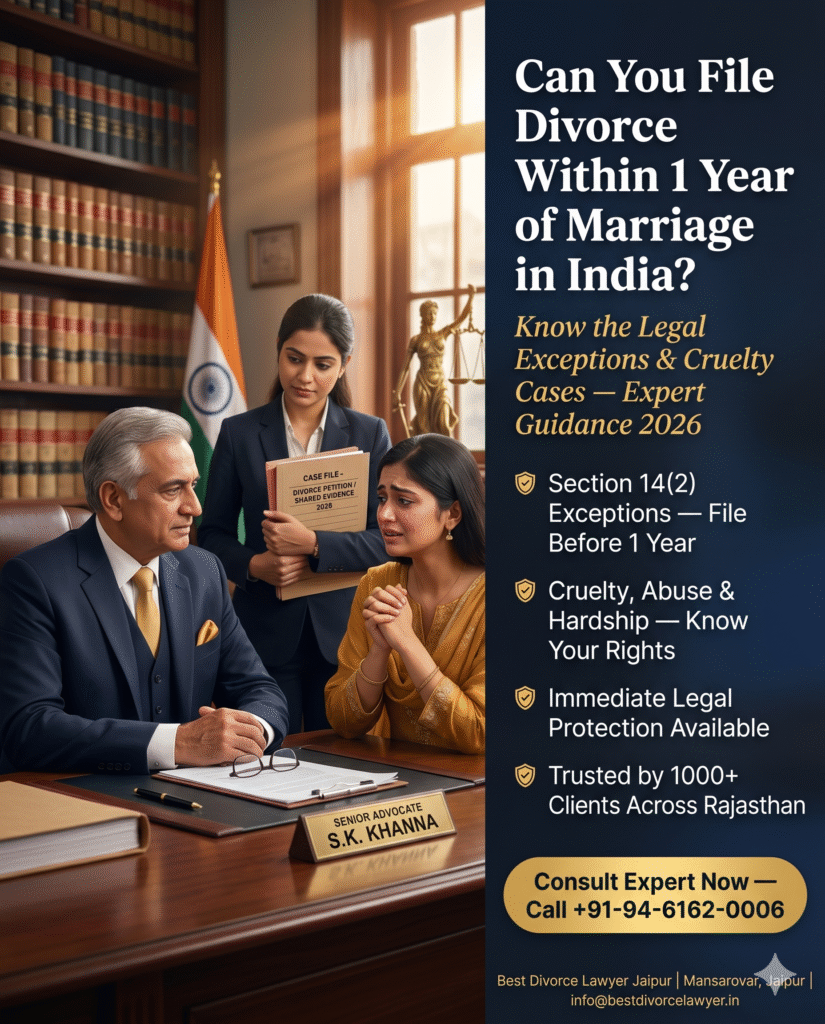
What Is the 1-Year Bar on Divorce in India? – Complete Definition & Overview
Under Section 14 of the Hindu Marriage Act, 1955, no court shall entertain a petition for divorce unless one year has passed from the date of marriage. This provision was introduced to prevent hasty decisions and to encourage reconciliation between couples.
Similarly, under the Special Marriage Act, 1954, and the Indian Divorce Act, 1869 (applicable to Christians), comparable waiting period provisions apply. The law presumes that within the first year, couples should be given a reasonable opportunity to resolve differences.
However, Section 14(2) of the Hindu Marriage Act creates an important exception: a petitioner can approach the court before one year if the case involves:
- Exceptional hardship suffered by the petitioner, or
- Exceptional depravity on the part of the respondent
This means if your spouse has subjected you to physical violence, mental torture, sexual abuse, abandonment, or any form of extreme cruelty, the best divorce lawyer in Jaipur can file an urgent petition on your behalf without waiting for the mandatory one-year period.
To understand the full scope of the Hindu Marriage Act, visit India’s official legislative portal for authenticated legal text.
Why Indian Clients Prefer Best Divorce Lawyer Jaipur for Such Complex Cases
Filing a divorce within one year of marriage is not a routine legal task — it requires exceptional legal skill, evidentiary preparation, and courtroom authority. Here is why clients across Rajasthan and India trust Best Divorce Lawyer Jaipur:
- 15+ Years of Dedicated Family Law Experience in Rajasthan High Court and district family courts
- Proven Track Record in cruelty, domestic violence, and exceptional hardship divorce cases filed before the one-year mark
- Certified Family Law Specialists with deep expertise in the Hindu Marriage Act, Special Marriage Act, and Domestic Violence Act, 2005
- Client-First Approach — confidential consultations, transparent fee structures, and 24/7 legal support
- Located at 47D SMS Colony, Shipra Path, Mansarovar, Jaipur 302020 — easily accessible to residents of Jaipur, Ajmer, Jodhpur, and across Rajasthan
- Multilingual Legal Team fluent in Hindi, English, and Rajasthani dialects — ensuring every client is fully understood
As one of our clients from Mansarovar, Jaipur shared: “I was trapped in an abusive marriage and didn’t know I could file within months. Best Divorce Lawyer Jaipur saved my life.”
As the best law firm in Jaipur for divorce, we combine legal excellence with genuine empathy — because your future deserves nothing less.
Step-by-Step Legal Process to File Divorce Within 1 Year in India
If you believe your situation qualifies under exceptional hardship or exceptional depravity, here is the structured legal process followed by the top divorce lawyer in Rajasthan:
Step 1 — Initial Legal Consultation Meet with our leading family lawyer in Mansarovar Jaipur to assess whether your case qualifies under Section 14(2).
Step 2 — Evidence Collection & Documentation Gather all supporting evidence, including:
- Medical reports (for physical abuse)
- FIR copies, police complaints
- Text messages, emails, witnesses
- Photographs, videos (if applicable)
Step 3 — Filing the Application Under Section 14(2) Our team prepares a strong application citing exceptional hardship or depravity, supported by a detailed affidavit.
Step 4 — Court Hearing for Leave to File Petition The family court grants or denies permission. Our best divorce lawyer in India 2026 presents compelling arguments for immediate relief.
Step 5 — Filing the Main Divorce Petition Once leave is granted, the divorce petition is formally filed under the appropriate personal law (Hindu, Muslim, Christian, or Special Marriage Act).
Step 6 — Interim Relief Applications (If Required) We simultaneously file for:
- Interim maintenance
- Protection orders under the Domestic Violence Act
- Child custody orders (if applicable)
Step 7 — Final Hearing & Decree The court issues its divorce decree after examining all evidence and hearing both parties.
Key Legal Insights, Compliance Rules & Benefits
Understanding the legal framework is essential for any Indian client pursuing divorce within one year:
Relevant Laws:
- Hindu Marriage Act, 1955 — Section 14 (one-year bar and exceptions)
- Special Marriage Act, 1954 — Section 27
- Protection of Women from Domestic Violence Act, 2005
- Indian Penal Code — Section 498A (cruelty by husband/relatives)
What Qualifies as “Exceptional Cruelty” in Indian Courts:
- Physical violence and bodily harm
- Mental harassment, emotional blackmail, verbal abuse
- Dowry demands and financial coercion
- Sexual assault within marriage (recognized increasingly by courts)
- Abandonment, desertion, or threats to life
Real Case Scenario: A 26-year-old woman from Jaipur approached Best Divorce Lawyer Jaipur just 4 months after her marriage. Her husband had subjected her to daily physical abuse and made repeated dowry demands. Our legal team successfully obtained court permission under Section 14(2) and secured both a divorce decree and interim maintenance — all within 8 months.
Important Compliance Note: The petition must be accompanied by an affidavit clearly establishing that waiting until one year would cause irreparable harm to the petitioner. Incomplete affidavits are the most common reason for rejection at this stage.
Common Mistakes & Legal Challenges Indian Clients Face
Many Indian clients unknowingly make errors that delay or destroy their case. As the best divorce lawyer in India 2026, we have identified the most critical mistakes:
Mistake 1 — Assuming Any Hardship Qualifies Not every difficult marriage meets the court’s threshold for “exceptional hardship.” Routine arguments or incompatibility do not qualify. Courts require strong, documented evidence.
Mistake 2 — Weak or Incomplete Documentation Clients often fail to preserve crucial evidence — deleted messages, unrecorded incidents, or delayed medical examinations weaken the case significantly.
Mistake 3 — Filing Without Specialized Legal Help This is not a case for general practitioners. Section 14(2) applications require precision legal drafting. Best Divorce Lawyer Jaipur specializes exclusively in such sensitive cases.
Mistake 4 — Ignoring Interim Relief Options Many victims do not know they can seek immediate protection orders under the Domestic Violence Act even before the divorce petition is admitted.
Mistake 5 — Miscommunication with the Court Procedural delays caused by incorrect filing, wrong court jurisdiction, or missing signatures can set back a case by months.
Our Solution: At Best Divorce Lawyer Jaipur, our dedicated legal team reviews every document, prepares bulletproof affidavits, and ensures zero procedural errors — giving our clients the strongest possible chance for success.
Expert Tips from Leading Legal Advisors at Best Divorce Lawyer Jaipur
Our senior family law advocates share these professional insights for Indian clients:
- “Document everything from Day One.” — Preserve all communication records, medical bills, and police reports. Courts rely heavily on documentary evidence in Section 14(2) applications.
- “File a DV complaint simultaneously.” — The Domestic Violence Act, 2005 offers immediate protection and can strengthen your divorce case significantly in Jaipur’s family courts.
- “Do not reconcile under pressure.” — Many families push victims to return to abusive marriages. This can weaken your legal position. Consult the top divorce lawyer in Rajasthan before making any decision.
- “Understand your financial rights.” — Interim maintenance, Stridhan recovery, and property rights are separate from the divorce petition. Assert them early.
- “Jurisdiction matters.” — File your petition in the correct family court. Jaipur’s Family Court, Rajasthan High Court, and district courts each have specific jurisdictional rules. Best Divorce Lawyer Jaipur handles this seamlessly.
- “Speed and precision win cases.” — Every day in an abusive marriage is a day too many. The best law firm in Jaipur for divorce ensures your case moves forward without unnecessary delays.
Conclusion + Strong Call to Action
Filing for divorce within one year of marriage in India is legally possible — but only under specific, well-documented exceptional circumstances such as cruelty, abuse, or extreme depravity. The law, while protective of marriage as an institution, equally protects the fundamental rights and safety of every individual.
Key Takeaways:
- Section 14(2) of the Hindu Marriage Act permits early divorce petitions in exceptional hardship or depravity cases
- Cruelty — physical, mental, financial, or sexual — is the strongest ground
- Strong documentation and expert legal representation are non-negotiable
- Interim relief under the Domestic Violence Act can be sought immediately
You do not have to wait — and you do not have to suffer alone.
Best Divorce Lawyer Jaipur — the most trusted name in family law across Rajasthan and India — is here to protect your rights, your dignity, and your future.
📍 47D SMS Colony, Shipra Path, Mansarovar, Jaipur – 302020 📧 info@bestdivorcelawyer.in 📞 +91-94-6162-0006
👉 Book Your Confidential Legal Consultation Today — Available 7 Days a Week
❓ FAQ Section
Q1. Can I file for divorce within 1 year of marriage in India for cruelty? Yes. Under Section 14(2) of the Hindu Marriage Act, 1955, you can petition the court before one year if your case involves exceptional hardship or cruelty. The best divorce lawyer in Jaipur at Best Divorce Lawyer Jaipur can evaluate your case and file the necessary application immediately.
Q2. What qualifies as “exceptional cruelty” under Indian divorce law? Exceptional cruelty includes physical violence, mental harassment, repeated dowry demands, sexual abuse, and life threats. Indian courts have progressively expanded this definition. Consult the top law firm in Jaipur — Best Divorce Lawyer Jaipur — to assess if your situation qualifies under Section 14(2).
Q3. How long does the early divorce process take in Jaipur’s family courts? The timeline varies, but with strong documentation and expert legal representation from the best law firm in Jaipur for divorce, many exceptional hardship cases receive court leave within 4–8 weeks of application. Total resolution timelines depend on complexity and court scheduling.
Q4. Can a woman file divorce within 1 year of marriage in India? Absolutely. Both husband and wife can invoke Section 14(2) under the Hindu Marriage Act. Women facing domestic violence also have additional protections under the Domestic Violence Act, 2005. The leading family lawyer in Mansarovar Jaipur at Best Divorce Lawyer Jaipur specializes in protecting women’s legal rights.
Q5. Is the 1-year bar applicable to all religions in India? The one-year bar applies under the Hindu Marriage Act and Special Marriage Act. Different rules apply under Muslim Personal Law, the Indian Divorce Act (Christians), and the Parsi Marriage Act. For accurate guidance based on your religion and circumstances, contact Best Divorce Lawyer Jaipur — the best divorce lawyer in India 2026 — at +91-94-6162-0006.
