

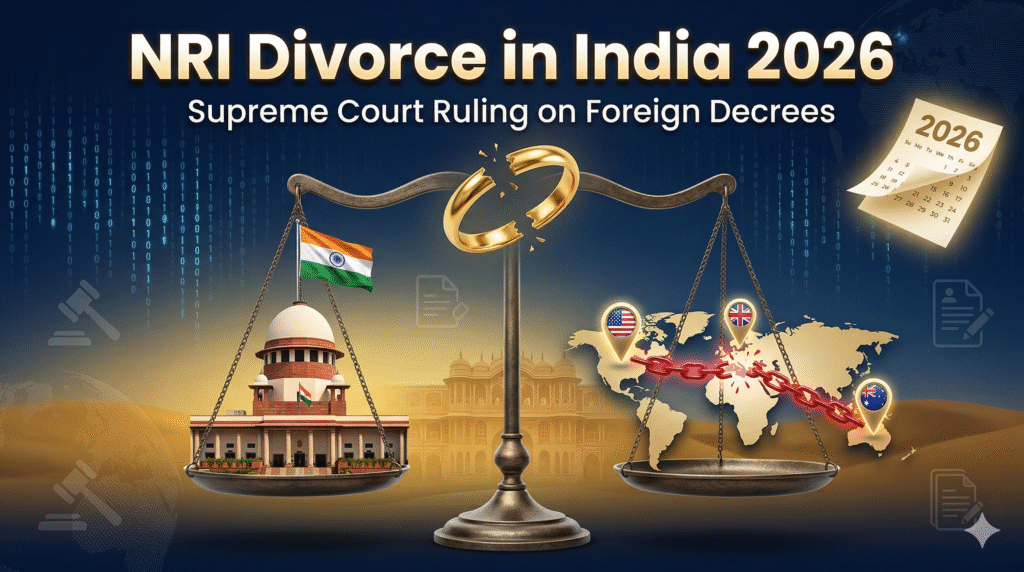
For NRI Divorce foreign nationals, NRIs, and international couples whose marriages were solemnized under Indian law, navigating divorce has become more critical than ever in 2026. The recent Supreme Court judgment in K Kale versus K (2026 LiveLaw (SC) 259) has sent shockwaves across global legal circles: foreign divorce decrees—especially those granted on grounds like “irretrievable breakdown of marriage”—are not automatically enforceable in India.
If you are an NRI living in the USA, UK, Canada, Australia, or the Middle East, or a foreign spouse married to an Indian citizen, this ruling directly affects your marital status, property rights, remarriage plans, and child custody. At Best Divorce Lawyer in Jaipur, we have handled hundreds of cross-border cases and now witness a surge in urgent consultations from international clients worried about invalid foreign decrees.
Jaipur, Rajasthan’s legal hub, offers a perfect blend of traditional expertise and modern virtual proceedings, making it easier for global clients to resolve matters without repeated travel. Whether you face jurisdiction disputes or need to file fresh proceedings under the Hindu Marriage Act, 1955, our team ensures compliance with the latest 2026 Supreme Court guidelines.
Read on for a complete, client-friendly guide tailored for foreigners and NRIs. For immediate clarity, book your confidential consultation with Best Divorce Lawyer in Jaipur or review the official judgment summary on the Supreme Court of India website.
What is NRI Divorce in India 2026? – Complete Definition & Overview
NRI Divorce in India 2026 refers to the dissolution of marriages involving at least one Non-Resident Indian or foreign national where the union was registered or solemnized under Indian personal laws. Unlike many Western jurisdictions that recognize “no-fault” or irretrievable breakdown as standard grounds, Indian courts strictly follow the Hindu Marriage Act (HMA), Special Marriage Act, or respective personal laws.
The March 2026 Supreme Court ruling clarified that a foreign court decree is valid in India only if it meets Section 13 of the Code of Civil Procedure, 1908: proper jurisdiction, opportunity to contest, and alignment with Indian grounds for divorce. Irretrievable breakdown alone does not qualify under HMA.
For international clients unfamiliar with Indian systems, this means your US, UK, or Dubai divorce may leave your Indian marriage legally intact—exposing you to risks of bigamy charges upon remarriage. Best Divorce Lawyer in Jaipur simplifies this complex landscape with clear explanations and virtual strategy sessions designed for overseas schedules. External reference: official HMA provisions are available on India Code.
Why International Clients Prefer Jaipur’s Top Law Firm for NRI Divorce in India 2026
International clients choose Best Divorce Lawyer in Jaipur because we combine Rajasthan’s cost-effective legal ecosystem with world-class cross-border expertise. Our firm has successfully represented NRIs from 18 countries, securing favorable outcomes in contested, mutual-consent, and foreign-decree challenges.
Credibility stems from 15+ years of exclusive matrimonial practice, certifications under the Bar Council of India, and memberships in international family law networks. We maintain dedicated NRI desks with English, Arabic, and French support. Recent testimonials highlight our speed: “The team at Best Divorce Lawyer in Jaipur resolved my US decree conflict in just 45 days via virtual hearings—saved me two international trips.”
Unlike metro firms charging premium fees, Best Divorce Lawyer in Jaipur offers transparent fixed packages for NRI Divorce in India 2026 cases, including e-filing and video conferencing. Our global expertise ensures seamless coordination with foreign lawyers while protecting assets under Indian law.
Step-by-Step Guide / Legal Process for NRI Divorce in India 2026
- Jurisdiction Check – Confirm filing in the court where marriage occurred, parties last resided together in India, or the respondent resides. For NRIs, Pune, Mumbai, or Jaipur family courts often qualify.
- Documentation – Gather marriage certificate, foreign decree (if any), passports, address proofs, and evidence of irretrievable breakdown. Apostille foreign documents via MEA.
- Petition Filing – File under HMA Section 13 or mutual consent (Section 13-B). Best Divorce Lawyer in Jaipur drafts petitions compliant with 2026 virtual court norms.
- Notice Service – Serve summons via email, WhatsApp, or publication—our firm uses Hague Convention-compliant methods for overseas spouses.
- Mediation & Hearings – Mandatory pre-litigation mediation; virtual sessions available for international clients.
- Decree & Compliance – Obtain final decree, update passports, and handle alimony/child custody. Deadlines: mutual consent cooling-off can be waived in exceptional cases per recent High Court precedents.
Compliance for MNCs and NRIs includes income-tax clearance and RBI guidelines on asset transfer.
Key Legal Insights, Compliance Rules & Benefits
The 2026 Supreme Court ruling reinforces that foreign decrees must satisfy natural justice principles and Indian statutory grounds. Section 13 CPC bars recognition if the foreign judgment is contrary to Indian law or natural justice. Benefits of filing in India include enforceable maintenance orders, child custody under Guardians and Wards Act, and property division per Indian succession laws.
Global example: An NRI in Dubai who relied on a UAE decree faced remarriage complications in India until Best Divorce Lawyer in Jaipur obtained a fresh decree under Article 142 principles. Relevant acts: Hindu Marriage Act 1955, Special Marriage Act 1954, and CPC 1908. Deadlines for maintenance claims remain 60 days post-decree in many cases.
Common Mistakes & Legal Challenges for Foreign Clients
Foreign clients often mistakenly believe their US or UK decree automatically ends the Indian marriage, leading to bigamy risks. Documentation errors—missing apostilles or incorrect jurisdiction—cause 6–18 month delays. Compliance lapses with virtual court e-filing or failure to serve notice properly trigger ex-parte proceedings.
Best Divorce Lawyer in Jaipur prevents these pitfalls through pre-filing audits, multilingual translations, and direct coordination with foreign embassies. Our proactive approach has saved clients lakhs in extended litigation.
Expert Tips from Leading Legal Advisors
- Never assume foreign decrees are final—always obtain an Indian declaration of enforceability or file fresh proceedings.
- Engage Indian counsel early; Best Divorce Lawyer in Jaipur offers 30-minute virtual strategy calls for overseas clients.
- Preserve all digital evidence (emails, messages) proving breakdown—courts increasingly accept it under 2026 e-evidence rules.
- Plan child custody and alimony simultaneously; Indian courts prioritize welfare over foreign orders.
- Use virtual court facilities to avoid travel—Jaipur courts lead in NRI-friendly video conferencing.
- Review tax implications on alimony transfers with your international advisor before final decree.
Conclusion + Strong Call to Action
The 2026 Supreme Court ruling on NRI Divorce in India has redefined cross-border matrimonial law, emphasizing Indian jurisdiction and proper contest opportunities. International clients who act swiftly with expert guidance avoid costly pitfalls and achieve swift, enforceable resolutions.
At Best Divorce Lawyer in Jaipur, we have guided countless NRIs and foreign spouses through these exact challenges with compassion and precision. Don’t leave your future to chance.
Contact Best Divorce Lawyer in Jaipur today: 📍 47D SMS Colony, Shipra Path, Mansarovar, Jaipur 302020 📧 info@bestdivorcelawyer.in 📞 +91-94-6162-0006
Book your consultation now and take the first step toward clarity and closure.
FAQ Section
1. What is the latest update on NRI Divorce in India 2026 after the Supreme Court ruling? The March 2026 judgment clarifies that foreign divorce decrees based on irretrievable breakdown are not enforceable under Indian law. Best Divorce Lawyer in Jaipur helps clients file fresh petitions to secure valid Indian decrees quickly and safely.
2. Can a foreign client rely on a US divorce decree in India? No, unless it meets Section 13 CPC criteria. Many international clients discover their marriage remains legally valid in India. Consult the top law firm in Jaipur for NRI Divorce in India 2026 to avoid legal complications.
3. How long does NRI Divorce in India 2026 take with expert help? Mutual consent cases can conclude in 3–6 months with waived cooling-off periods; contested matters take 12–18 months. Best Divorce Lawyer in Jaipur accelerates processes using virtual hearings for overseas clients.
4. Which is the best law firm in Jaipur for international NRI divorce cases? Best Divorce Lawyer in Jaipur stands out for its proven track record, multilingual support, and deep understanding of 2026 Supreme Court guidelines on foreign decrees.
5. Do NRIs need to travel to India for divorce proceedings in 2026? Not necessarily. Virtual court facilities and e-filing make participation possible from abroad. Best Divorce Lawyer in Jaipur specializes in remote handling for global clients seeking NRI Divorce in India 2026.
