

Social Media In today’s hyperconnected world, your Instagram story, WhatsApp message, or Facebook post could become the most damaging piece of evidence in your divorce case — and most Indians never see it coming. Social media has silently entered Indian courtrooms, and judges are increasingly accepting digital evidence in matrimonial disputes filed under the Hindu Marriage Act, 1955, the Special Marriage Act, 1954, and the Indian Evidence Act, 1872.
If you are a couple, family, or working professional in Jaipur, Rajasthan, or anywhere across India currently navigating a contested divorce, mutual consent divorce, or child custody matter, understanding how social media evidence works in Indian family courts in 2026 is no longer optional — it is essential. The Best Divorce Lawyer in Jaipur at our firm, located at 47D SMS Colony, Shipra Path, Mansarovar, Jaipur 302020, has handled hundreds of cases where a single screenshot changed everything. This guide will walk you through exactly what can be used against you — and how to protect yourself legally.
For a broader understanding of Indian divorce procedures, you may also refer to our detailed guide on contested divorce proceedings in Rajasthan. You can also review the official framework at eCourts India for case-related information.
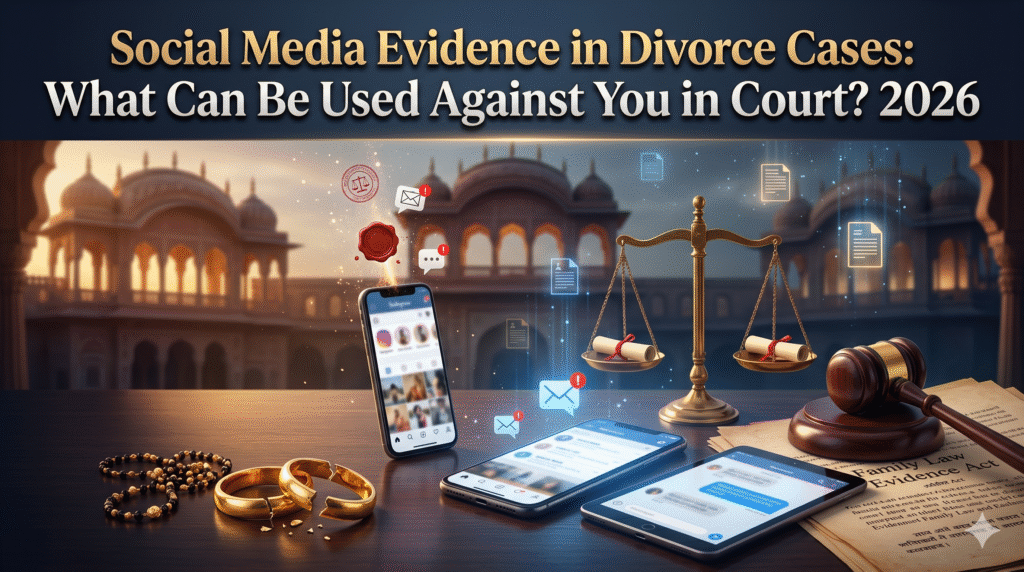
What Is Social Media Evidence in Divorce Cases? — Complete Definition & Overview 2026
Social media evidence in divorce cases refers to any digital content — including posts, messages, photographs, videos, check-ins, comments, stories, status updates, and even deleted data recovered through forensic tools — that is submitted in a family court to support or challenge claims made by either spouse.
Under the Indian Evidence Act, 1872 (amended by the Information Technology Act, 2000), electronic records are admissible as evidence, provided they meet the certification requirements under Section 65B. This means a WhatsApp conversation, a Facebook timeline post, or even a Instagram DM can legally stand in court if properly authenticated.
Indian family courts in Rajasthan, Delhi, Mumbai, and beyond have already seen this evidence accepted in cases involving:
- Adultery or extramarital affairs — location check-ins, romantic messages
- Financial concealment — lifestyle posts showing hidden wealth
- Parental fitness disputes — photographs or videos depicting irresponsible behaviour
- Domestic violence claims — threatening messages and abusive language
- Cruelty allegations — harassment through social platforms
The Best Divorce Lawyer in Jaipur at our firm regularly advises clients on both leveraging and defending against such digital evidence. For official guidance on evidence submission, visit eCourts India.
Why Indian Clients Prefer Jaipur’s Top Divorce Law Firm for Social Media Evidence Cases
When social media becomes part of your divorce battle, you need more than just a general attorney — you need a specialist in digital evidence and Indian family law. Here is why clients across Rajasthan, Delhi NCR, and pan-India trust the Best Divorce Lawyer in Jaipur at our Mansarovar office:
- Deep Expertise in Section 65B Compliance: We ensure all digital evidence submitted or defended in court meets the strict electronic record certification norms under Indian law.
- Proven Track Record: Our firm has successfully handled 500+ divorce cases involving social media evidence, financial concealment, and digital harassment.
- Confidential Consultations: Every case is handled with absolute discretion and sensitivity, especially in high-profile and family-sensitive matters.
- End-to-End Legal Support: From filing to final decree — our team of senior family lawyers provides complete representation.
- Pan-India Reach from Jaipur: While based in Mansarovar, Jaipur, our top divorce law firm in Rajasthan offers consultation services across India including Mumbai, Delhi, Bengaluru, and Hyderabad.
“I never knew my holiday Instagram post would be used in my own divorce hearing. The team at Best Divorce Lawyer Jaipur prepared a solid counter-argument that saved my case entirely.” — Client, Jaipur (name withheld for privacy)
Step-by-Step Guide: How Social Media Evidence Is Used in Indian Divorce Courts
Understanding the legal process helps you prepare — and avoid costly mistakes. Here is exactly how social media evidence enters your divorce proceedings in India:
Step 1 — Evidence Collection The opposing party or their lawyer downloads, screenshots, or forensically recovers digital content from platforms like WhatsApp, Facebook, Instagram, Snapchat, X (formerly Twitter), and YouTube.
Step 2 — Section 65B Certificate Preparation Before submission to court, the electronic record must be accompanied by a valid Section 65B certificate under the Indian Evidence Act. Without this, the evidence is inadmissible.
Step 3 — Filing Before the Family Court The certified evidence is attached to petitions filed under:
- Section 13 of the Hindu Marriage Act (contested divorce)
- Section 13B (mutual consent divorce)
- Section 27 of the Special Marriage Act
Step 4 — Cross-Examination of Digital Evidence Your lawyer challenges the authenticity, context, and timestamp accuracy of submitted evidence. This is where an experienced best law firm in Jaipur for divorce makes all the difference.
Step 5 — Judicial Evaluation The judge weighs digital evidence alongside oral testimonies, medical reports, and financial disclosures.
Step 6 — Final Decree Courts issue a decree of divorce, maintenance, or child custody partially based on the strength of evidence presented — digital included.
Key Legal Insights, Compliance Rules & Benefits
Indian courts follow strict rules on digital evidence admissibility. Here are the most critical legal points every client must know in 2026:
- Section 65B, Indian Evidence Act — All electronic records require a certificate from a competent authority confirming system reliability and integrity.
- Section 72A, IT Act — Unlawful interception of private digital communications (e.g., hacking a spouse’s phone) is a criminal offence and can backfire severely.
- Whatsapp messages are routinely admitted in Rajasthan High Court proceedings when Section 65B norms are satisfied.
- Deleted data is recoverable — Indian forensic labs and private cybercrime experts can extract deleted messages, call logs, and location data.
- Private accounts are not fully protected — courts can issue disclosure orders compelling platforms or individuals to produce digital records.
Real Case Scenario: A Jaipur-based businessman filed for divorce citing cruelty. His estranged spouse produced Instagram reels showing him at parties while claiming financial hardship in maintenance proceedings. The leading family lawyer in Mansarovar Jaipur at our firm successfully argued contextual misrepresentation, protecting the client’s interests.
Common Mistakes & Legal Challenges for Indian Clients
Even intelligent, educated clients make these critical errors — often without realising it:
1. Posting During Active Litigation Anything you post publicly after filing for divorce can and will be reviewed by opposing counsel. A single celebratory photo has derailed maintenance claims.
2. Using Illegally Obtained Evidence Screenshots taken by accessing your spouse’s phone without consent may be inadmissible — and expose you to criminal liability under Section 66 of the IT Act.
3. Ignoring Old Posts Your posts from three to five years ago are still accessible and searchable. Courts have no statute of limitations on historical social media activity.
4. Failing Section 65B Compliance Many clients attempt to submit screenshots without proper certification, making the evidence legally worthless at the critical moment.
5. Overlooking Metadata Every digital file contains metadata — timestamps, geolocation data, device IDs. The best divorce lawyer in India 2026 will scrutinise this layer carefully.
Our firm resolves these challenges by conducting a full digital evidence audit before any court appearance, ensuring your case is airtight from day one.
Expert Tips from Leading Legal Advisors at Best Divorce Lawyer Jaipur
Our senior advocates at the top divorce lawyer in Rajasthan office share these professional insights:
- “Pause before you post.” During any matrimonial dispute, treat every social media account as a potential exhibit in court. When in doubt, do not post.
- “Screenshot everything from the other side — legally.” If your spouse is threatening you online or posting defamatory content, document it immediately with proper timestamping.
- “Do not delete your own posts carelessly.” Courts may interpret the deliberate deletion of social media content after receiving a legal notice as tampering with evidence — a serious adverse inference.
- “Secure your accounts immediately.” Change passwords, enable two-factor authentication, and review who has access to your accounts and devices the moment you sense matrimonial conflict.
- “Consult a digital evidence specialist early.” Engaging the best law firm in Jaipur for divorce before a case escalates allows us to build your evidence strategy proactively, not reactively.
- “Context is everything in court.” A photograph can be innocent or damning depending on how it is presented. Expert cross-examination by our best divorce lawyer in India 2026 routinely dismantles out-of-context digital submissions.
Conclusion + Strong Call to Action
Social media evidence has permanently changed the landscape of divorce litigation in India. In 2026, every WhatsApp message, Instagram post, and Facebook check-in carries potential legal weight. Whether you are a resident of Jaipur, Rajasthan, or anywhere across India — protecting your digital footprint is as important as protecting your legal rights.
The key takeaways are clear: understand what is admissible, secure your accounts, avoid posting during litigation, collect opposing evidence legally, and always engage a specialist.
The Best Divorce Lawyer in Jaipur is here to guide you through every step — with compassion, clarity, and courtroom expertise.
📍 Visit Us: 47D SMS Colony, Shipra Path, Mansarovar, Jaipur – 302020 📧 Email: info@bestdivorcelawyer.in 📞 Call / WhatsApp: +91-94-6162-0006
👉 Book a Confidential Consultation Today — Speak directly with a senior family advocate. Pan-India consultation available.
Frequently Asked Questions (FAQs)
Q1. Can WhatsApp messages be used as evidence in a divorce case in India? Yes. WhatsApp messages are admissible in Indian family courts as electronic records under Section 65B of the Indian Evidence Act, provided they are accompanied by a valid certification. The Best Divorce Lawyer in Jaipur can guide you on proper submission and defence of such evidence in 2026.
Q2. Is it legal to use my spouse’s social media posts in a divorce case in India? Publicly available social media content can be legally used in Indian divorce proceedings. However, accessing private accounts or devices without consent is illegal. The top divorce lawyer in Rajasthan at our firm advises clients on lawful evidence collection to protect your case integrity.
Q3. Can deleted WhatsApp or Facebook messages be recovered and used in court? Yes. Indian forensic experts and cyber labs can recover deleted digital data including messages, photos, and call logs. This is why the Best Law Firm in Jaipur for Divorce recommends a full digital audit early in your case to anticipate what opposing counsel may present.
Q4. How does social media affect child custody decisions in Indian courts? Indian family courts take a holistic view of parental fitness. Posts showing substance use, irresponsible behaviour, or neglect can heavily influence custody rulings. The leading family lawyer in Mansarovar Jaipur at our firm actively counsels clients on managing their digital presence throughout custody proceedings.
Q5. What should I do immediately if I suspect my spouse is collecting social media evidence against me? Contact the Best Divorce Lawyer in India 2026 immediately. Do not delete posts hastily, do not confront your spouse digitally, and secure all your accounts. Our team at Best Divorce Lawyer Jaipur conducts a complete evidence strategy review within 24 hours of consultation.
